Sunday, May 24, 2026 — This morning, we headed back to the bakery for breakfast. In previous days, the streets had been busy, even early in the morning. This morning, the streets were nearly deserted. However, we did pass several piles of vomit, so we’re guessing it was busy last night.
Back at the apartment, we tried to buy tickets to the Acropolis online. 1300 was the first available time slot, which was too late in the day for us. We figured we’d try in person — even if we couldn’t get in, we would still get a great view, plus there were many other archeological sites surrounding the Acropolis.
We found out that taxis were hard to come by on Sunday mornings, but we did eventually get one. This was the north entrance.
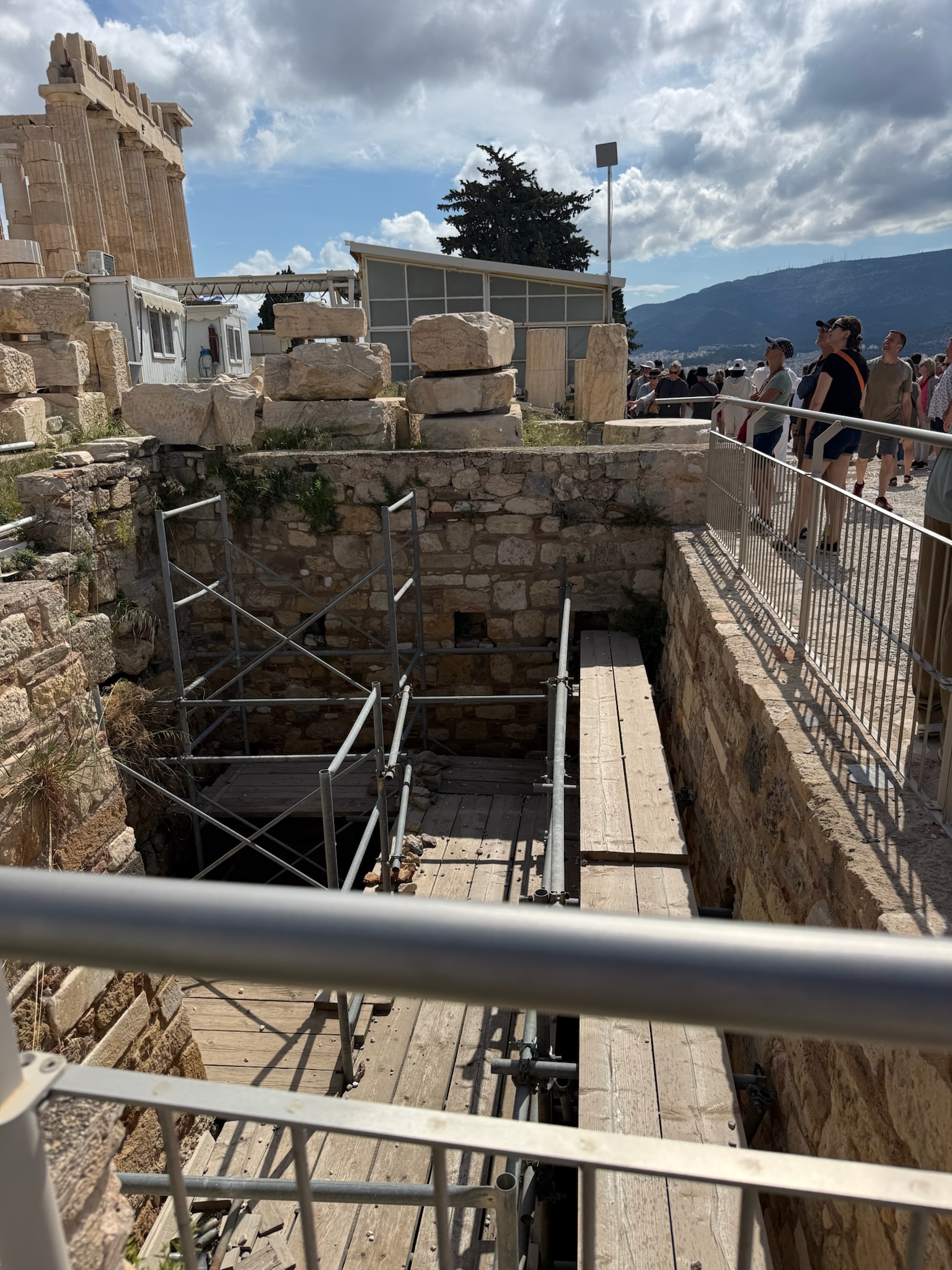
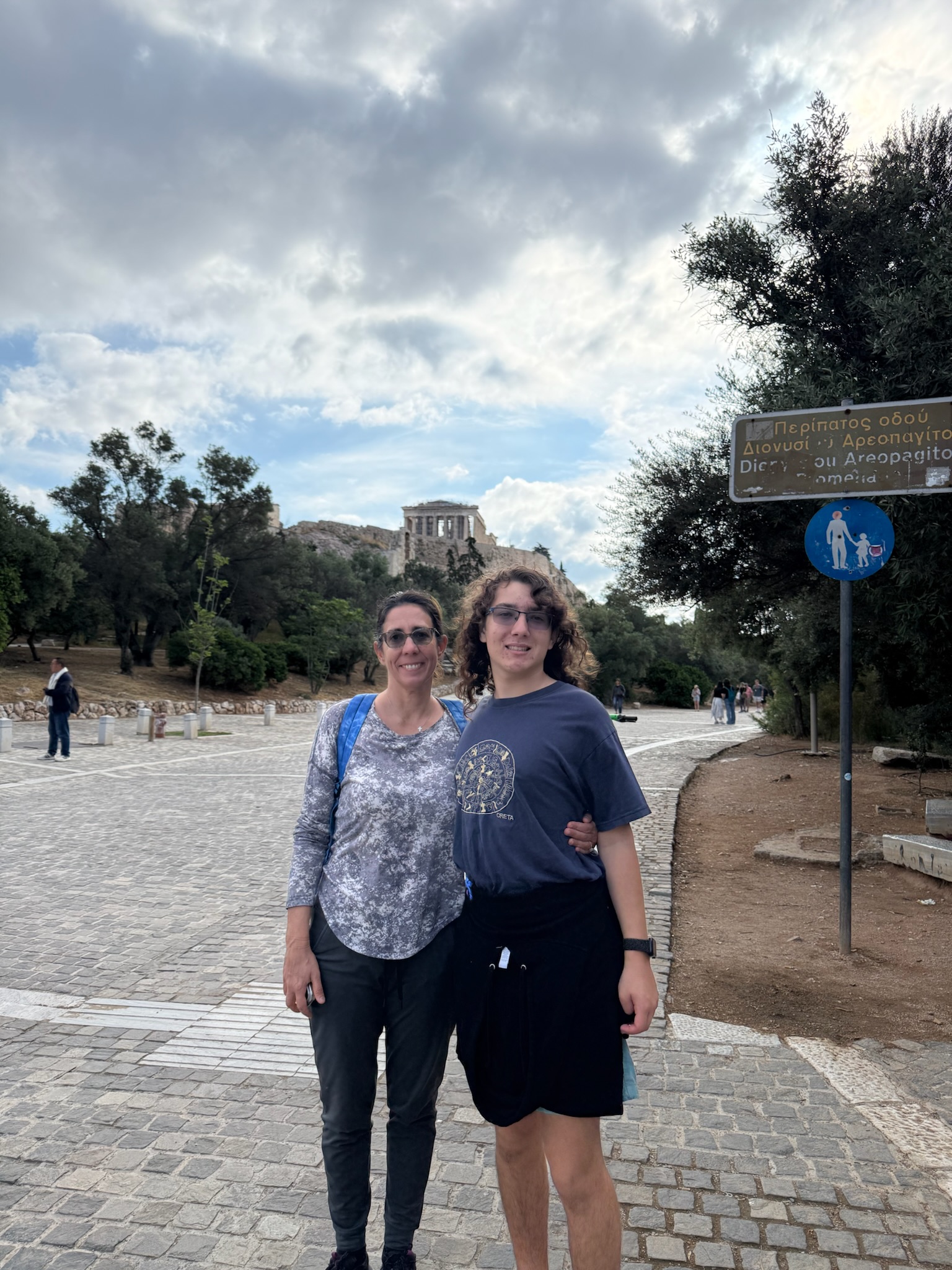
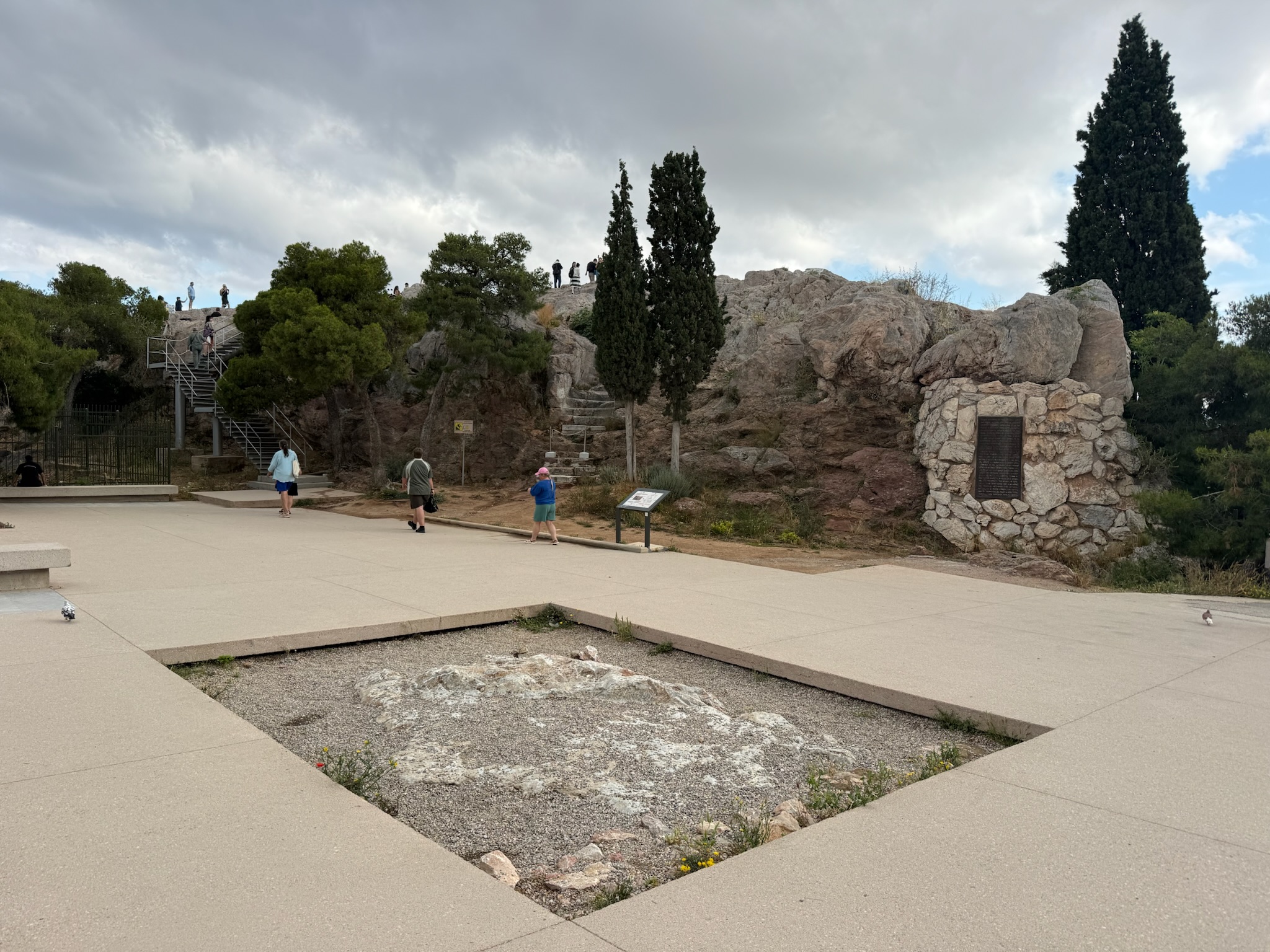
We walked up the marble paved walkway to the ticket booth. The first available tickets were for 1000, with a 0945 entry. Yay! The tickets cost 30 Euros ($33 USD) for adults; children 17 and younger were free… but we had to show Keith’s passport to prove that he really was a child. We had more than a half-hour to kill, so we walked over to a nearby viewpoint. The sign you can see in the photo talked about the Apostle Paul meeting with the Athenian political leaders. We were unclear if the meeting happened at this exact site or on nearby Areopagus Hill, which could be seen from this viewpoint.
The stairs led to the top of a large marble rock that the tourists fanned out across. The rock was slippery! Here was the view of the Athens.
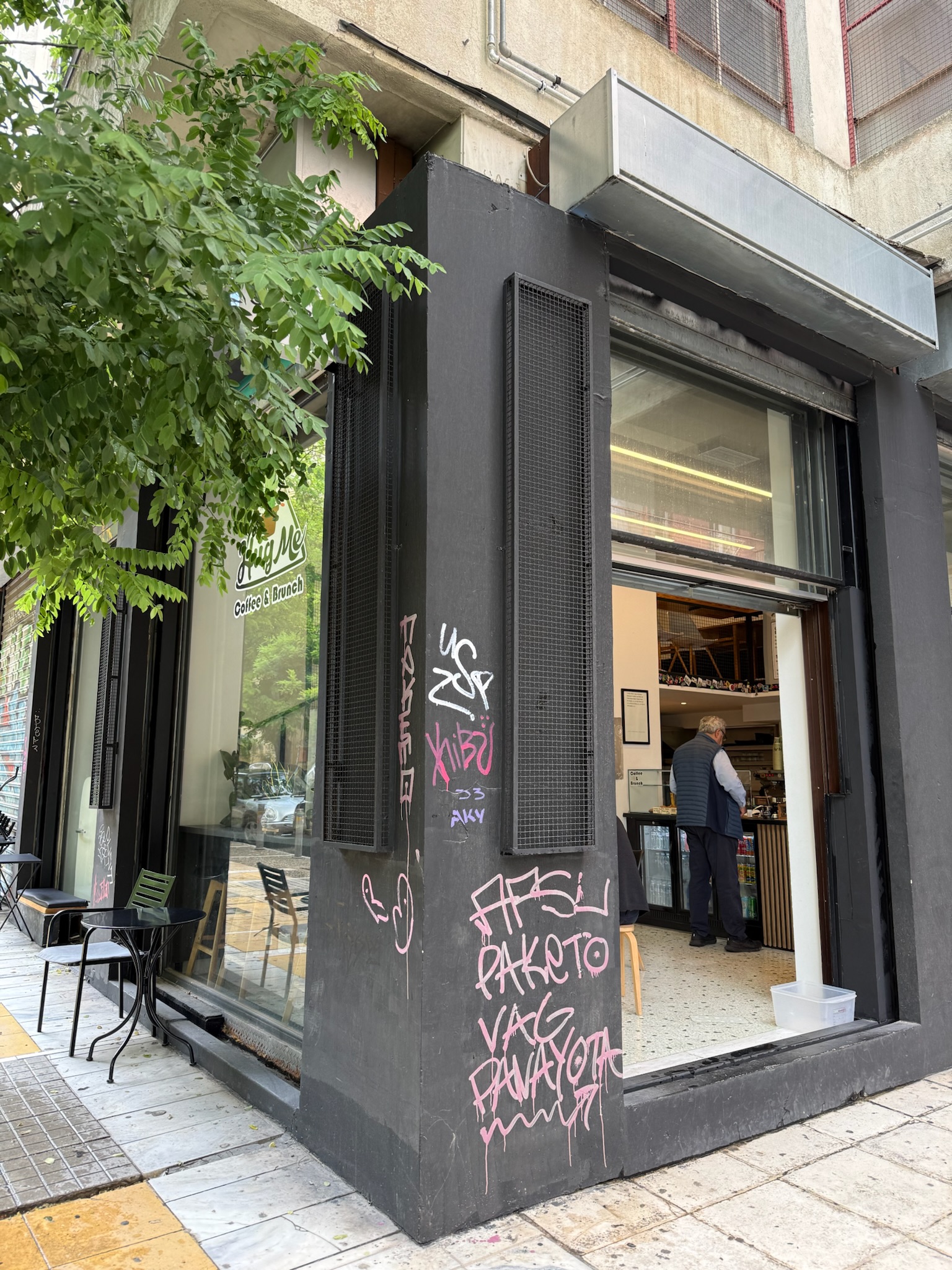
Saturday, May 23 — This morning, Christi and Eric ran more errands. It was raining pretty hard, which everyone said was unusual for the time of year. We let Keith stay at the apartment, where he spent the morning playing video games. Near one of the errands that we ran, we saw a brunch cafe called Just Hug Me. We had breakfast food for lunch, which was nice since breakfast food was hard to come by in Greece.
In the afternoon, Christi had a meeting. Eric decided that Keith needed to get some exercise, so they walked to a group of sightseeing attractions about 1.5 miles away. It was uphill most of the way, and some of the “sidewalks” were staircases. It was a steep climb up!
The first stop was the Zappeion Megaron. It was a large gathering area with various buildings. Unfortunately for Eric and Keith, the NBA final 4 festival was happening in the main part of the grounds, so they needed tickets to go inside. The area was packed with people, so they couldn’t even get all that close to it. From the little they saw, they described it as a classical Greek building that looked like it was maybe a concert hall.
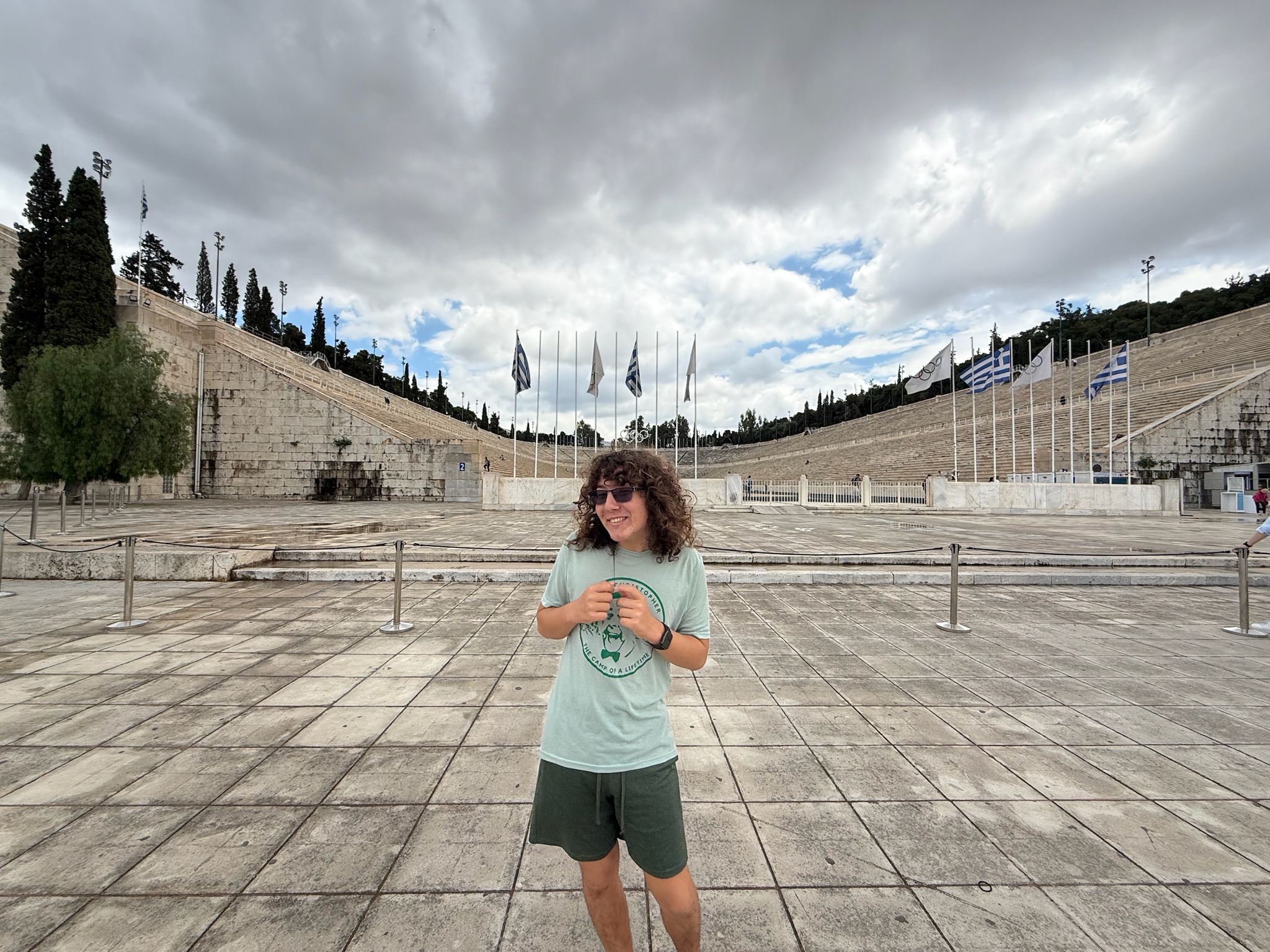
The next stop was the Panathenaic Stadium, which was where the Panathenaic games began in 556 BC. The games were a religious and athletic festival celebrated every four years in honor of the goddess Athena. Initially, it was a simple racecourse in a ravine between two hills. There was no formal seating; the spectators sat on the natural slopes. In 330 BC, they built a stadium here. In 144 AD, they rebuilt it in marble and it had a capacity of 50,000 seats. After the rise of Christianity in the 4th century, it was largely abandoned. The stadium was excavated in 1869 and they began refurbishment work. They began hosting Olympic Games here even while the refurbishment work was taking place. It was the only stadium still lin use composed of 100% marble. Interestingly, there was a river that ran through the ravine that flowed underneath the stadium.
Continued from yesterday”¦ Once we had gone through the museum, we headed to another well preserved building, the Church of the Holy Apostles. It was built in the 11th century over the ruins of a 2nd century AD building called the Nymphaion. We have no clue what kind of building the Nymhaion could have possibly been, but the name is certainly intriguing. The church was restored in the 1950’s. The church looks pretty similar on the outside to the other churches around Greece we have seen so far. The inside is only partially restored. They found some of the original wall paintings, so the walls are mostly white with big chunks of ornate, but faded, art splashed here and there on the walls. There isn’t much in there by way of furniture, either.
Continued from yesterday”¦ we walked a few blocks to the Olympeion, which is a temple constructed to honor Zeus, the god of the sky and king over all the gods of ancient Greece. The site has been considered a holy place to Zeus since 600 BC. In the early days, they simply worshipped in an empty field. Over the years, several efforts were made to build a temple. The work would start, only to have the project abandoned for one reason or another. Many years later, the work would start again, only to be abandoned again. The temple was finally completed in 132 AD, under Roman Emperor Hadrian. It was one of the most impressive temples of the Roman Empire, with 104 columns. There were two enormous statues inside of equal size, one of Zeus and one of Hadrian. In the 5th century BC, the temple began to deteriorate. During the Middle Ages, the temple was converted to a Christian church, and under the Ottomans a mosque was built on the site. By 1852, only 16 columns were left standing. A storm knocked one of the columns over. It was believed that the falling of the columns liberates evil, and an outbreak of cholera at about the same time was blamed on the column’s fall.
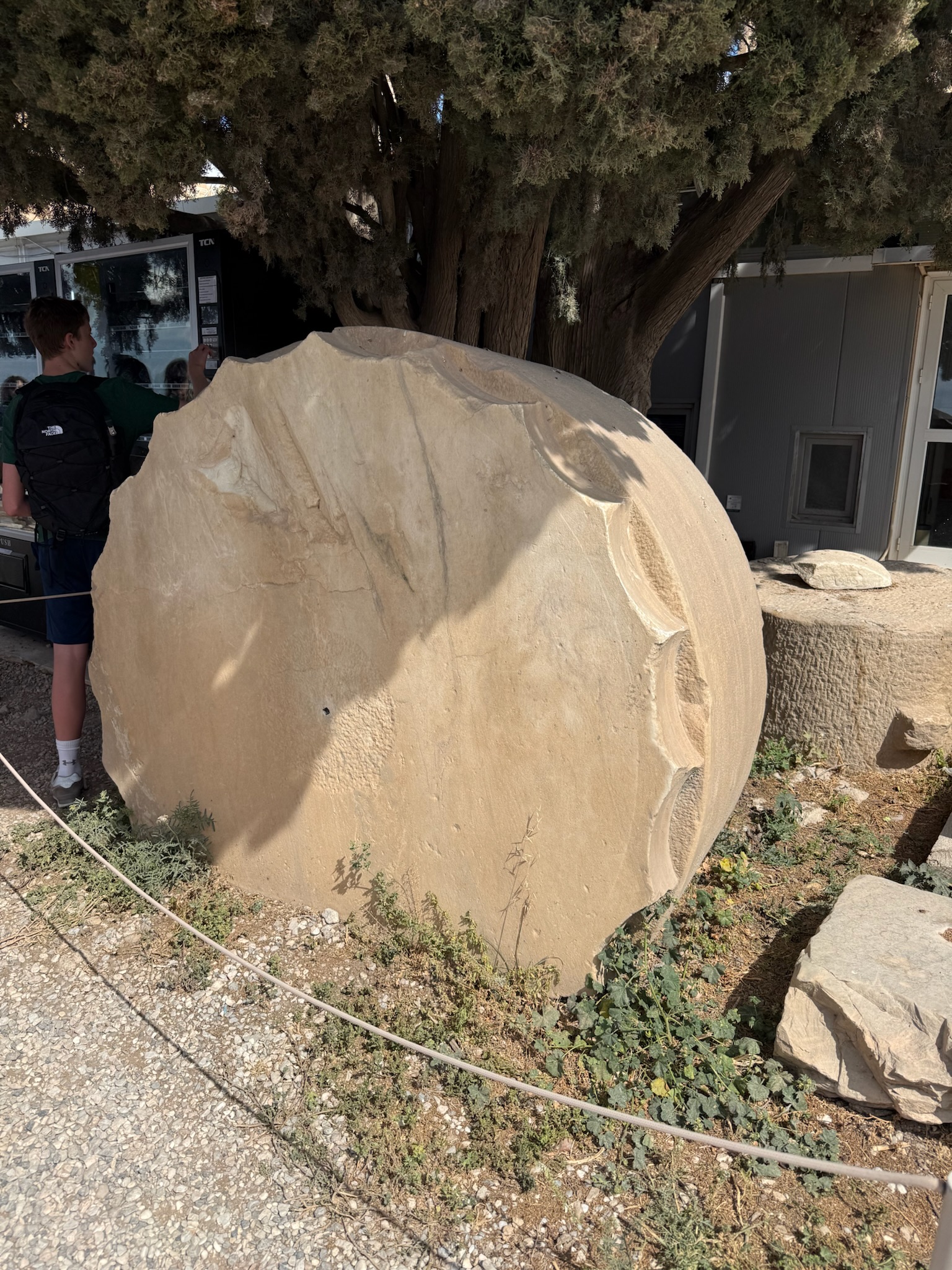
This site isn’t anywhere close to being as put back together as the Acropolis is. There is the foundation of the temple in the middle of a field. There are a few columns left standing on the foundation. There is the one column that fell in 1852, still lying where it fell. The building was enormous in its day, very large and very tall. We were fascinated by the fallen column. Standing, the pillars look like they were carved from one giant piece of marble, but really they carefully carved are discs stacked together.
On the grounds is another impressive monument, called Continue reading →